Hungarian TV Austria: Full Guide, Channels & Prices 2026
Hungarian TV in Austria, live: 150+ channels (M1, M4 Sport, RTL) from €5/mo. EU portability blocks you after 30 days — IPTV doesn't. Setup in 5 min.
The ~100,000 Hungarians living in Austria have four main ways to watch live Hungarian TV in 2026: the free Mediaklikk stream of M1, M2 and M4 Sport (from an Austrian IP, only up to the EU portability 30-day cap, then geo-blocked), the RTL+ and TV2 Play commercial streams (also limited to 30-day portability), the Austrian-market Hungarian packages (One TV Austria, Magyar TV Pack, €25–40/mo with smaller line-ups), or an independent Hungarian IPTV subscription from €12/mo (€5/mo on the annual Basic plan). The single most important myth to clear up: many people assume that because Austria is in the EU, their Hungarian apps work without limits in Vienna — yet Austria is precisely the textbook case where the EU portability rule (Regulation 2017/1128) fails to solve the problem: once your habitual residence is Austrian, after the 30-day annual cap, Mediaklikk and RTL+ geo-block you exactly like they would in London. Based on our tests in Vienna (Favoriten, Ottakring, Floridsdorf), Graz, Linz and Salzburg, on A1, Magenta Telekom, Drei and LIWEST networks, only independent Hungarian IPTV delivers unlimited 4K UHD access to live M1, RTL Klub, TV2 and M4 Sport — with no time limit.
Updated: September 2, 2026 — Author: Hungary IPTV Team
Quick summary:
- ~100,000 Hungarians live in Austria (Vienna, Graz, Linz, Salzburg, Innsbruck, Klagenfurt), on top of the autochthonous Hungarian minority in Burgenland — almost all want live Hungarian TV at home-quality
- The EU portability 30-day cap is the key: Mediaklikk, RTL+, TV2 Play and the Magenta TV Now app work from an Austrian IP only 30 days per year under Regulation 2017/1128 — after that they geo-block, because your habitual residence is now Austrian
- Austrian cable and ORF carry zero or minimal Hungarian content — the mandatory ORF household fee (ORF-Beitrag, €15.30/mo) includes no Hungarian channels, while One TV Austria and Magyar TV Pack offer a Hungarian package at €25–40/mo with reduced line-ups
- Independent Hungarian IPTV: Basic €12/mo (€5/mo on the annual plan), Hungarian-focused Premium €29/mo (about €13/mo annually) — 150+ Hungarian channels live (M1, M2, M3, M4 Sport, M5, Duna TV, Duna World, RTL Klub, RTL+, TV2, TV2 Play, ATV, HírTV, Spektrum, Cool, Film+, Sport1, Sport2) plus 50,000+ international channels up to 4K UHD, with no time limit
- Tested in Vienna (Favoriten, Ottakring, Floridsdorf), Graz, Linz and Salzburg — on A1 Glasfaser, Magenta Internet, Drei and LIWEST, in the same time zone (CET / CEST), so Hungarian broadcasts run in real time
Table of contents
- What "Hungarian TV in Austria" means — 4 categories
- Why watching Hungarian TV from Austria is complicated
- How to set up Hungarian TV in Austria in 5 minutes
- Comparison: which solution actually works in Austria?
- Basic or Premium: which one fits you in Austria?
- Troubleshooting: the 6 most common issues in Austria
- Pros and cons
- Frequently asked questions
- Conclusion and next step
What "Hungarian TV in Austria" means — 4 categories
"Hungarian TV in Austria" can mean four technically very different things, and most disappointment comes from people mixing them up. The crucial distinction is which one works permanently and which only lasts until the EU portability 30-day cap. Below we separate all four so you know exactly what to expect from Vienna, Graz or Salzburg.
1. Free public-media OTT — Mediaklikk (mediaklikk.hu), atv.hu, hirtv.hu. These run on Hungarian servers designed for Hungarian IPs. From Austria they are accessible 30 days per year under the EU portability rule, after which a geo-block kicks in because your habitual residence is Austrian. Includes M1, M2, M3, M4 Sport, M5, Duna TV and Duna World.
2. Commercial streaming — RTL+, TV2 Play, Magenta TV Now (app version). These are also geo-blocked and only temporarily accessible via EU portability. RTL+ basic (RTL Klub live) is free with registration from a Hungarian IP, premium content is paid — but from an Austrian IP the 30-day cap applies here too.
3. Austrian-market Hungarian packages — One TV Austria, Magyar TV Pack and a few Austrian cable operators' Hungarian options. These work legally from an Austrian IP, but typically at €25–40/mo with a reduced 70–85 channel line-up, often with a contract term and a set-top box. The full Hungarian channel palette (especially sports channels and VOD) is rarely included.
4. Independent Hungarian IPTV — a diaspora-built service like Hungary IPTV. It does not rely on territorial licensing, so it works without limits from any Austrian city, with no time cap, 150+ Hungarian channels, 50,000+ international channels and 4K UHD quality. This is the only category that streams reliably beyond the 30-day portability cap. We compare its pricing against domestic operators in our Hungarian IPTV subscription and IPTV providers guides.
Try Hungary IPTV before paying anything
Why watching Hungarian TV from Austria is complicated
Watching Hungarian TV from Austria isn't held back by bandwidth — Austria is in the same time zone as Hungary, and A1 Glasfaser or Magenta Internet is more than enough for 4K. The real barrier is legal and geographic: Hungarian services block by IP address, and EU portability only unlocks them temporarily.
Barrier 1: geographic (IP-based) blocking
Mediaklikk and the commercial streams decide whether access is Hungarian based on the viewer's IP address. An Austrian A1, Magenta or Drei IP is instantly identified as "foreign", and the service shows the familiar "This content is not available in your region" message. This isn't a bug — it's a consequence of the territorial licensing of Hungarian broadcasting rights.
Barrier 2: the EU portability 30-day cap
Many people assume the EU's portability regulation, in force since 2018 (Regulation 2017/1128), solves the problem. It doesn't. The rule covers temporary travel only — for example, when a subscriber based in Hungary spends two weeks in Vienna for business. Anyone who lives permanently in Austria (with a registered address in Vienna, Graz or Salzburg) cannot use it, because their "habitual residence" is no longer Hungary. In practice, most Hungarian services grant 30 days per year of access from an Austrian IP, then geo-block. Unlike the United Kingdom — where Brexit means there is no portability at all — Austria does have the 30-day grace window, but for permanent residents it still expires. This is the most critical misunderstanding, which we cover country by country in our Hungarian IPTV providers abroad pillar article.
Barrier 3: the ORF-Beitrag and the gap in Austrian cable
Since January 2024, every Austrian household must pay the ORF-Beitrag (€15.30/mo) — regardless of whether they watch ORF at all. Yet this fee includes not a single Hungarian channel. Austrian cable and streaming packages (Sky Österreich, Magenta TV Austria) likewise carry zero Hungarian channels. In other words, a Hungarian family in Vienna often pays more for the ORF they don't watch than all Hungarian channels would cost with an independent IPTV service. This mirrors the German situation, but with Austria's own twist — we analyse the German market specifics (Deutsche Telekom, Vodafone DE) separately in our Hungarian TV from Germany article.
The Burgenland case deserves its own mention. Austria's autochthonous Hungarian minority — concentrated around Oberwart (Felsőőr), Unterwart (Alsóőr), Siget in der Wart (Őrisziget) and Oberpullendorf (Felsőpulya) — does receive legally mandated Hungarian-language programming from ORF, but the volume is symbolic: the "Adj' Isten magyarok" television magazine airs on ORF 2 Burgenland only a handful of times per year, complemented by short Hungarian-language slots on Radio Burgenland. That is a service measured in hours per year, not in channels. Households close to the border can sometimes still receive the Hungarian MinDig TV terrestrial signal with a rooftop aerial, but coverage fades quickly further west — which is why even in Burgenland, where Hungarian has been spoken for centuries, full Hungarian television realistically arrives over the internet.
How to set up Hungarian TV in Austria in 5 minutes
Setting up Hungarian IPTV in Austria takes 5 minutes: choose a plan with EUR pricing, receive Xtream Codes access on WhatsApp, install IPTV Smarters Pro or TiviMate on your device, and sign in — the 150+ Hungarian channels and EPG sync instantly. Because Austria is in the same time zone as Hungary, live broadcasts run in real time, with no need for catch-up.
The steps below apply to every popular Austrian device and ISP. We've also attached the full per-device guide to this article as HowTo structured data, so Google and AI search engines can display it step by step.
Step 1 — Choose a plan in EUR
Open the plans and pricing page and pick your service: Basic is €12/mo (€60 on the annual plan — €5/mo), the Hungarian-focused Premium is €29/mo (€160 annually — about €13/mo); 3-month and 6-month plans are also available. Payment is in EUR — SEPA transfer, Visa / Mastercard, Revolut, Wise and PayPal are all accepted from an Austrian bank account.
Step 2 — Activate on WhatsApp
Within 5 minutes of payment you receive the server URL, username and password (Xtream Codes API) on WhatsApp. Hungarian-language support is available 24/7 and is in the same time zone as you, so a question asked at 21:00 Vienna time gets an immediate reply.
Step 3 — Install the app on your device
- Amazon Fire TV Stick 4K Max (the most popular in Austria): install IPTV Smarters Pro from the Amazon Appstore, choose "Login with Xtream Codes API".
- Samsung Tizen / LG webOS Smart TV (Media Markt, Saturn): install IPTV Smarters Pro or IBO Player Pro from the built-in store.
- Android TV box / Google TV: TiviMate from Google Play is the best choice, with M3U or Xtream Codes support.
- Apple TV 4K / iPhone / iPad: IPTV Smarters Pro or GSE Smart IPTV from the App Store.
Step 4 — Fine-tune your connection (if needed)
On A1 Glasfaser, Magenta Internet, Drei and LIWEST the stream is stable by default. If it buffers between 20:00–22:00, switch to a wired (ethernet) connection, set the buffer to 20–30 seconds, or configure Cloudflare DNS (1.1.1.1). We walk through the full first-time setup in our Hungarian IPTV subscription guide.
A1 Glasfaser, Magenta cable, Drei 5G and LIWEST in practice
The four big Austrian access technologies behave differently under a live 4K stream, and knowing which one you are on is half the troubleshooting. A1 Glasfaser (fibre, expanding across Vienna and the larger towns) is the most consistent base we have tested: latency to central-European IPTV servers is low and steady, and the only tweak worth making is swapping the A1 box's default DNS for Cloudflare (1.1.1.1). Watch out for A1's rural Hybrid product, though — it bonds DSL with LTE, and when it fails over to the mobile leg the jitter rises; on Hybrid lines, raise the player buffer to 20–30 seconds from the start. Magenta's cable network (the former UPC footprint in Vienna, Graz and Klagenfurt) delivers high headline speeds, but coaxial segments are shared with the neighbourhood: in dense districts such as Favoriten or Ottakring the 20:00–22:00 window can sag, which a wired connection and a larger buffer absorb without visible stutter. Drei's 5G home internet handles Hungarian IPTV well — 4K included — but radio latency swings more than on fibre or cable: place the 5G modem at a window facing the mast, run ethernet from the modem to the TV, and prefer FHD if you live at the cell edge. LIWEST in Linz and Upper Austria behaves like a well-run regional cable network: our Linz customers stream 4K stably, with the same evening-peak advice applying as for Magenta.
Activate your trial in just a few minutes
Comparison: which solution actually works in Austria?
The table below compares the Hungarian TV solutions available in Austria by price, channel count, 4K support, EU portability cap and contract term. The most important column is the portability cap: it determines whether a solution works permanently or only 30 days per year.
| Solution | Monthly price (EUR) | Hungarian channels | 4K | EU portability cap | Contract | A1 / Magenta / Drei compatible |
|---|---|---|---|---|---|---|
| Mediaklikk (free) | €0 | ~7 (M1–M5, Duna) | No | 30 days/yr, then blocked | — | Yes, but limited |
| RTL+ | €0–5 | ~3 (RTL Klub, RTL Gold) | Partly | 30 days/yr, then blocked | — | Yes, but limited |
| Magenta TV Now (app) | €13 | ~70 | Partly | 30 days/yr, then blocked | None | Yes, but limited |
| One TV Austria | €25–35 | ~70–85 | Partly | None (Austrian licence) | 12–24 mo common | Yes |
| Magyar TV Pack | €30–40 | ~70 | Partly | None (Austrian licence) | Varies | Yes |
| ORF-Beitrag (mandatory) | €15.30 | 0 | Yes | — | — | — |
| Hungary IPTV Basic | €12 (annual: €5/mo) | 150+ | Yes (UHD) | No cap | None | Yes |
| Hungary IPTV Premium | €29 (annual: ~€13/mo) | 150+ (larger Hungarian selection) | Yes (UHD) | No cap | None | Yes |
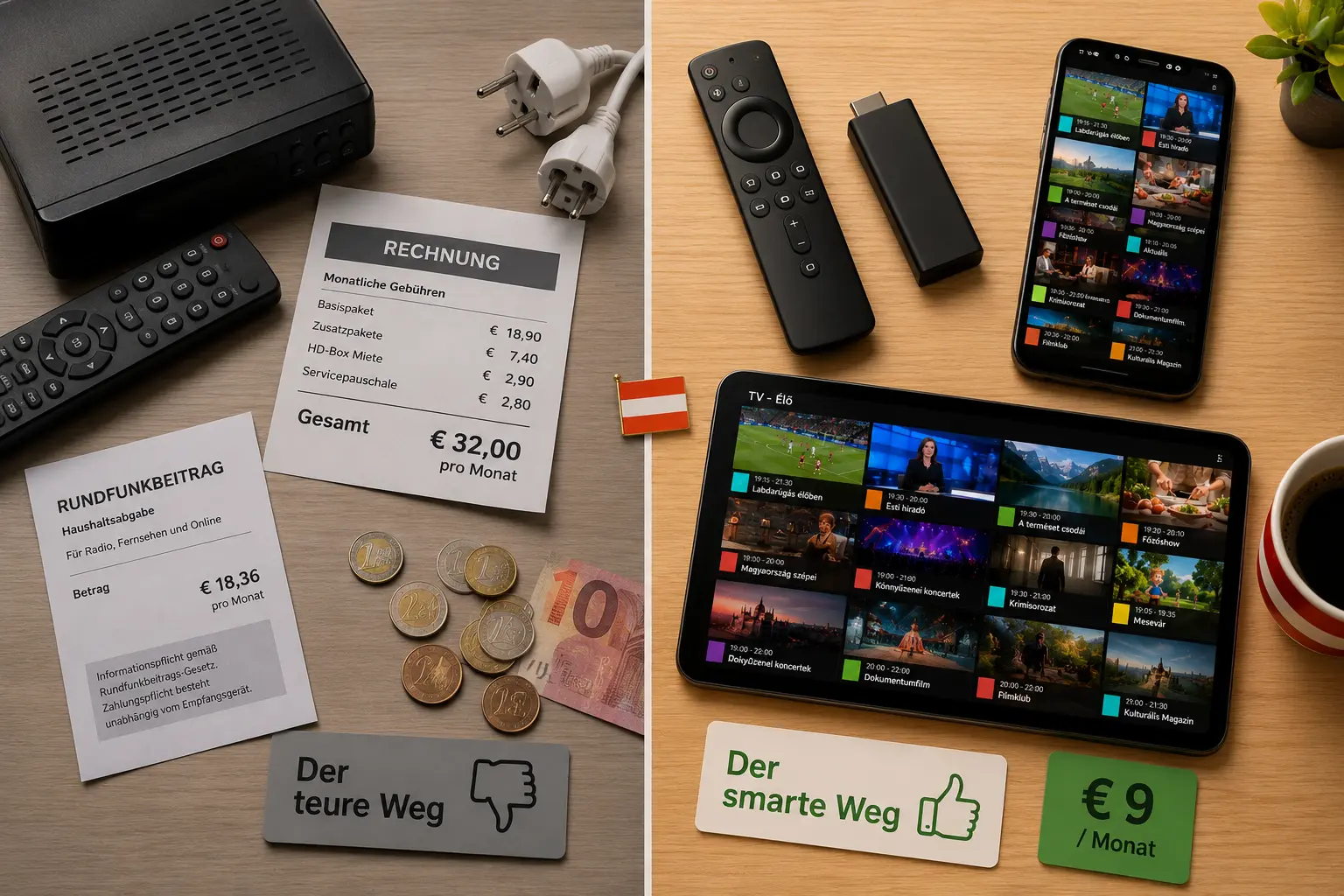
The numbers speak for themselves: for the price Magenta TV Now (€13/mo) or One TV Austria (€25–35/mo) charge for 70–85 channels — either with a 30-day cap or a 12–24 month contract — Hungary IPTV Basic delivers 150+ Hungarian channels at €12/mo with no time limit and no contract, while the Hungarian-focused Premium annual plan delivers the deepest Hungarian line-up at about €13/mo. And while the ORF-Beitrag deducts €15.30/mo from every Austrian household for 0 Hungarian channels, the annual Basic plan (€5/mo) costs less than a third of that, and even the Premium annual rate stays below it. We break down the full price comparison against domestic operator packages in our cheapest TV subscription in Hungary guide.
What a Viennese household actually pays: the full cost stack
Monthly TV cost is best judged as a stack, not a single subscription. A typical Hungarian family in Vienna starts from the mandatory ORF-Beitrag at €15.30 — unavoidable, and containing zero Hungarian channels. On top of that, a household that wants live sport and films the traditional way adds Sky Österreich, whose streaming bundles commonly run €25–45/mo depending on the sport and film mix, and then still needs a Hungarian layer such as One TV Austria at €25–35/mo. That stack lands at roughly €65–95 per month — before internet. The IPTV alternative collapses two of the three layers: ORF-Beitrag €15.30 (still mandatory) plus the annual Basic plan at €5/mo comes to €20.30/mo in total, and even with the Hungarian-focused Premium annual plan (~€13/mo) the total stays around €28.60/mo. Because the subscription also carries 50,000+ international channels — including extensive sports coverage — the separate Sky layer becomes redundant in many households. That is where the real saving hides: not in the Hungarian channels themselves, but in the Austrian pay-TV stack they replace.
Basic or Premium: which one fits you in Austria?
Since August 2026, Hungary IPTV comes in two services, and both work from Austria with no time limit. Basic is our standard package (€12/mo, or €60 on the annual plan — €5/mo): a large selection of English and international channels, with a good selection of Hungarian channels included. It is ideal for mixed households — say, an Austrian partner or kids who watch international content in Vienna, where English-language breadth matters alongside the Hungarian channels.
Premium is our newer service, developed specifically for Hungarian viewers (€29/mo, or €160 on the annual plan — about €13/mo): a larger Hungarian channel selection, more Hungarian movies and series, and additional Hungarian content that is not included in Basic. Depending on your Premium configuration, it supports up to 3 simultaneous streams — so the living-room TV, the kids' room and a tablet can run at the same time. If Hungarian television is your priority — and in the diaspora it usually is — the Premium annual plan is the best pick: per month it still stays below the mandatory ORF-Beitrag (€15.30).
With both services you can activate multiple devices under one subscription (on Basic, simultaneous streaming is a separately activated feature), and annual plans include a free IBO Pro Player activation. Catch-Up is available on selected channels.
Chat with our 24/7 support team
Troubleshooting: the 6 most common issues in Austria
These six issues cover the overwhelming majority of support requests from our Austrian customers. For each we give the cause and the concrete fix — most take 1–2 minutes to resolve.
"Mediaklikk doesn't work from Vienna"
Cause: you've hit the 30-day annual EU portability cap, or your habitual residence is Austrian, so a geo-block has kicked in. Fix: for permanent residents this can't be worked around legally on Mediaklikk without a VPN; stable, unlimited access comes from independent IPTV, which isn't based on IP licensing.
"The 4K stream buffers after 20:00"
Cause: during evening peak the local A1 or Magenta cell is more congested, or the WiFi is weak. Fix: switch to a wired ethernet connection, increase the buffer to 20–30 seconds in IPTV Smarters Pro / TiviMate settings, and set Cloudflare DNS (1.1.1.1).
"I can't log in with the Xtream Codes credentials"
Cause: a mistyped server URL, username or password, or an expired subscription. Fix: paste the details directly from the WhatsApp message (don't type them) and check for a trailing space. If the problem persists, Hungarian support helps 24/7.
"There's no EPG (TV guide)"
Cause: the EPG source didn't fully load on first launch. Fix: refresh the EPG manually in the app settings, or restart the app — the full Hungarian guide syncs within 1–2 minutes.
"Black screen on a particular channel"
Cause: that channel's source is temporarily unavailable, or the codec isn't supported on an older device. Fix: exit and re-enter the channel; if it persists, flag it on WhatsApp and you'll get an alternative source. On an old Smart TV, a Fire TV Stick 4K Max solves the codec problem.
"The A1 / Magenta router blocks the stream"
Cause: some Austrian routers' default DNS or filtering slows IPTV traffic. Fix: in the router admin page (often http://10.0.0.138 on A1) set manual DNS (1.1.1.1 or 8.8.8.8), or set the same directly in the Fire TV / Apple TV network settings. We collected the detailed device-specific tips in our best IPTV player guide.
Pros and cons
Pros
- 150+ Hungarian channels live (M1, M2, M4 Sport, RTL Klub, TV2, Duna TV, Sport1, Sport2) plus 50,000+ international channels up to 4K UHD
- No 30-day EU portability cap — unlike the uniform 30-day expiry on Mediaklikk, RTL+ and Magenta TV Now
- Basic €12/mo (€5/mo on the annual plan), Hungarian-focused Premium €29/mo (about €13/mo annually) — the Basic monthly rate is already below the mandatory ORF-Beitrag (€15.30/mo), with no contract
- Same time zone (CET / CEST) — live football, NB I, M4 Sport and the evening news run in real time, with none of the catch-up juggling required for Hungarian IPTV in the USA, where the time offset makes replay the priority
- Supports IPTV Smarters Pro, TiviMate, IBO Player, is M3U and Xtream Codes API compatible, and tested on A1 / Magenta / Drei / LIWEST
Cons
- A stable 25 Mbps+ connection is needed for 4K (A1 Glasfaser and Magenta Internet are more than enough, but weak WiFi can buffer)
- The trial requires manual activation via WhatsApp — there's no instant self-service sign-up
- There's no official Austrian-market set-top box — it's a browser- or app-based solution (more flexible in reality, but unusual for those attached to a traditional cable box)
Subscribe and start streaming in 5 minutes
Frequently asked questions
How can I watch Hungarian TV in Austria?
You can watch Hungarian TV in Austria in four ways: free Mediaklikk / RTL+ streaming (only up to the EU portability 30-day cap), an Austrian-market Hungarian package (One TV Austria, Magyar TV Pack, €25–40/mo), or independent Hungarian IPTV (from €12/mo, unlimited, 150+ channels). For permanent residents, only IPTV works without a time limit.
Why doesn't Mediaklikk work from Vienna?
Because Mediaklikk blocks by IP address, and the EU portability rule only grants access 30 days per year for temporary stays. If your registered address is Austrian, your "habitual residence" is no longer Hungary, so a geo-block kicks in after 30 days.
How long does EU portability let me use Hungarian apps in Austria?
Up to 30 days per year, for temporary stays. Regulation 2017/1128 is meant for users based in (and subscribing from) Hungary who travel to Austria temporarily — not for the diaspora living there permanently.
How much does Hungarian IPTV cost in Austria?
Hungary IPTV offers two services: Basic is €12 monthly (€60 on the annual plan — €5/mo), while the Hungarian-focused Premium is €29 monthly (€160 annually — about €13/mo); 3-month and 6-month plans are also available, and annual plans include a free IBO Pro Player activation. Payment is in EUR via SEPA / card / Revolut / Wise / PayPal, and prices on the plans page are always kept up to date.
Do I still pay the ORF household fee if I only watch Hungarian TV?
Yes — the ORF-Beitrag (€15.30/mo) has been mandatory for every Austrian household since January 2024, regardless of whether you watch ORF. But it contains no Hungarian channels, so you need a separate solution (such as IPTV) for Hungarian TV. Many families are surprised that even the Basic monthly rate (€12) is below the mandatory ORF fee, while the annual Basic plan (€5/mo) costs less than a third of it.
What's the best Hungarian IPTV provider in Vienna?
Choose a provider built for the diaspora (not IP-licensed), delivering 150+ Hungarian channels in 4K, with 24/7 Hungarian-language WhatsApp support and EUR payment. We summarise the criteria on our FAQ page.
Does Hungarian IPTV work on A1, Magenta, or Drei broadband?
Yes. We've tested it on A1 Glasfaser, Magenta Internet, Drei and LIWEST; the stream is stable by default. If it buffers during evening peak, a wired connection and Cloudflare DNS (1.1.1.1) fix it. For 4K, 25 Mbps+ is recommended.
Can I watch live NB I and M4 Sport from Austria?
Yes. Because Austria is in the same time zone as Hungary (CET / CEST), full NB I, Magyar Kupa and M4 Sport coverage runs in real time — with no time difference. Independent IPTV is the only solution that delivers this with no 30-day cap.
Does Hungarian IPTV work on Drei 5G home internet?
Yes. Drei's 5G home internet carries 4K Hungarian IPTV well, but radio latency varies more than on A1 fibre or Magenta cable. Place the 5G modem at a window facing the mast, connect the TV by ethernet from the modem, and set the player buffer to 20–30 seconds. At the cell edge, FHD is the more reliable choice.
Is there any Hungarian-language programming on ORF in Burgenland?
Only a symbolic amount. ORF's minority-language (Volksgruppen) service broadcasts the "Adj' Isten magyarok" TV magazine on ORF 2 Burgenland a few times a year, plus short Hungarian slots on Radio Burgenland. No ORF or Austrian cable package carries full Hungarian channels, which is why Burgenland households also rely on IPTV.
How much does a complete TV setup cost per month for a Hungarian family in Vienna?
With the traditional stack — mandatory ORF-Beitrag (€15.30) + Sky Österreich (€25–45) + a Hungarian package such as One TV Austria (€25–35) — the realistic total is €65–95/mo. With IPTV, the same household pays the ORF-Beitrag plus €5/mo (annual Basic) or ~€13/mo (annual Premium): €20.30–28.60/mo in total.
Conclusion and next step
If you live permanently in Austria and want to watch live Hungarian TV in 4K, with 150+ channels, beyond the EU portability 30-day cap, then an independent Hungarian IPTV service is the only solution that genuinely works with no time limit from Vienna to Salzburg. Mediaklikk, RTL+ and Magenta TV Now are all official Hungarian services, but from an Austrian IP they last only 30 days per year — then they block. The Austrian-market packages (One TV Austria, Magyar TV Pack) are more expensive and narrower, and the ORF-Beitrag delivers 0 Hungarian channels for its mandatory €15.30/mo. Get started in 5 minutes: choose a plan on the pricing page and start watching Hungarian TV tonight — in real time, at home-quality.
The Hungary IPTV Team has been helping customers in Hungary, Europe, Canada and the USA enjoy seamless IPTV streaming since 2022. Diaspora customers in Vienna, Graz, Linz and Salzburg have been testing the service since 2023 — our Hungarian-language 24/7 support is available in the same time zone on WhatsApp for setup, troubleshooting, and subscription questions.